
The Hormuz Effect: How 25 Days of War Reshaped Global Prices
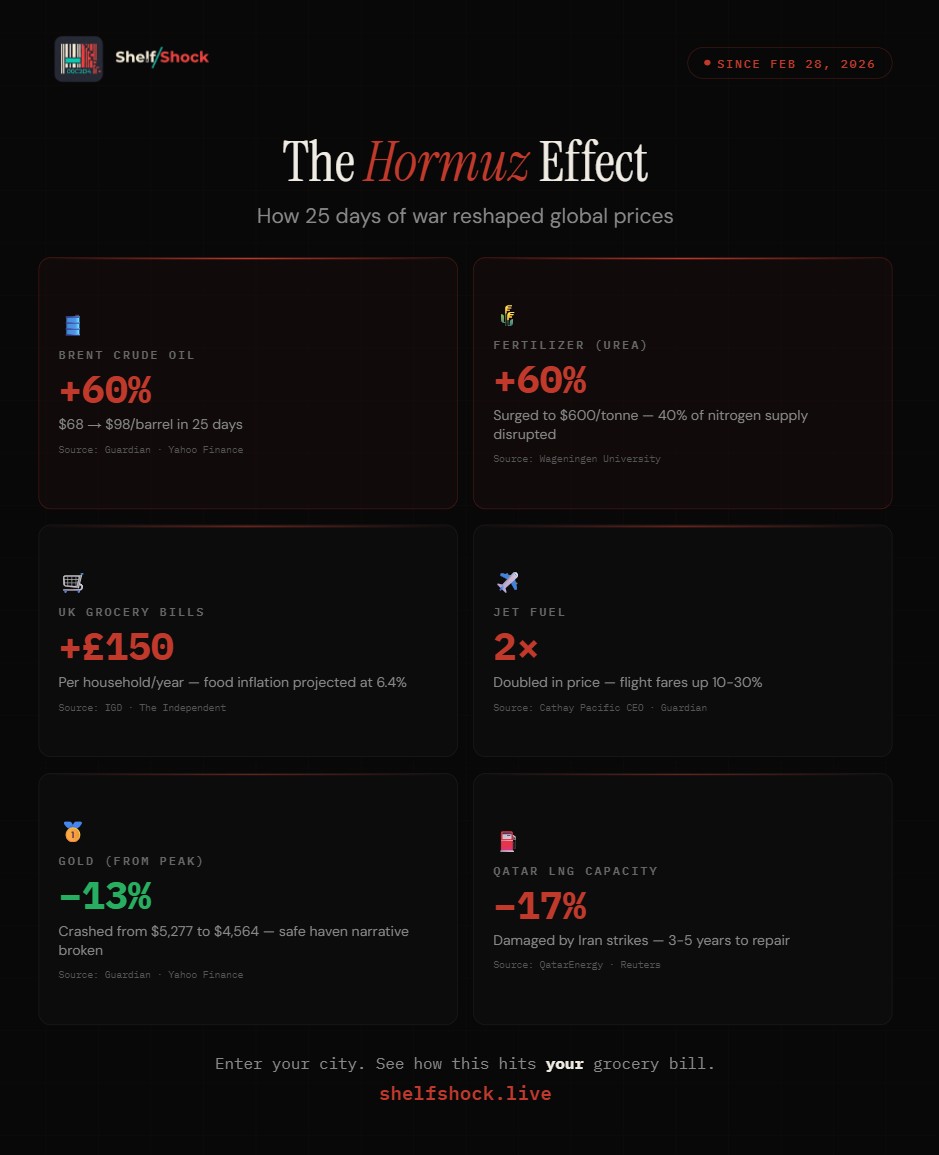
Brent crude up 60%. Fertilizer up 60%. UK grocery bills up £150/year. Jet fuel doubled. Gold crashed 13%. Qatar LNG capacity down 17%. Here's the full picture of what 25 days of conflict have done to the global economy.
Twenty-five days ago, the US-Israel operation against Iran began. The Strait of Hormuz — the narrow waterway carrying 20% of the world's oil — effectively closed overnight. Insurance companies pulled coverage. Tankers stopped moving. And the price shocks started cascading through every supply chain on earth.
Here's what the numbers look like after less than a month.
Oil: +60% in 25 Days
Brent crude jumped from $68/barrel on February 28 to $98/barrel by March 25 — a 60% surge that puts it above every price point since 2022. WTI crude followed the same trajectory, climbing from $65 to over $90.
This isn't a speculative bubble. The Strait of Hormuz normally carries roughly 21 million barrels of oil per day. With that supply route effectively closed, Saudi Arabia and the UAE are scrambling to push oil through alternative pipelines, but their spare capacity covers barely half the shortfall. The 15-million-barrel daily gap is the largest supply disruption in modern history — larger than the 1973 Arab oil embargo, the 1990 Gulf War, and the 2019 Abqaiq drone attack combined.
Fertilizer: +60% and Rising
Urea prices have surged to $600/tonne, up 60% since the conflict began. According to Wageningen University researchers, approximately 40% of the world's nitrogen fertilizer supply flows through the Middle East. Qatar alone produced 6 million tonnes of urea annually — but Iran's March 17 strike on Qatari gas fields has damaged critical production infrastructure.
This is the number that should worry everyone most. Fertilizer doesn't just affect farming — it determines how much food the world can grow. With planting season underway across the Northern Hemisphere, farmers face an impossible choice: plant at vastly higher input costs, or reduce acreage and accept lower yields. Either path leads to higher food prices in 3-6 months.
UK Grocery Bills: +£150/Year Per Household
The Institute of Grocery Distribution (IGD) and The Independent report that British households face an estimated £150/year increase in grocery spending, with food inflation projected to hit 6.4%. The impact is already visible in cooking oil, bread, and egg prices — categories with the highest exposure to energy and fertilizer costs.
This isn't a UK-specific problem. Every country that imports oil, fertilizer, or grain — which is virtually every country — faces similar arithmetic. The specific numbers vary by currency and import dependency, but the direction is universal.
Jet Fuel: Doubled
Jet fuel prices have doubled since the conflict began, according to Cathay Pacific's CEO and reporting by The Guardian. Airlines are passing these costs through to passengers in the form of 10-30% fare increases, with some routes seeing even steeper hikes.
Aviation fuel is refined from crude oil, so the 60% Brent surge translates almost directly into airline operating costs. Budget carriers with thin margins are hit hardest — expect route cancellations and capacity reductions in the weeks ahead.
Gold: Crashed 13% from Peak
Gold hit an all-time high of $5,277/oz in the first week of the conflict as investors rushed into the traditional safe haven. Then it crashed. By March 25, gold had fallen to $4,564/oz — a 13% decline from its peak.
The crash shattered the simple "crisis = buy gold" narrative. What happened? A combination of margin calls (investors selling gold to cover losses elsewhere), profit-taking after the initial spike, and growing expectations that central banks would intervene with emergency liquidity. Gold remains historically elevated — up from pre-crisis levels around $3,800 — but the volatility has made it a poor store of value for anyone who bought at the top.
Qatar LNG Capacity: -17%
Iran's March 17 strike on Qatari gas infrastructure damaged approximately 17% of Qatar's LNG production capacity, according to QatarEnergy and Reuters. Qatar is the world's largest LNG exporter, and this damage is expected to take 3-5 years to fully repair.
For Europe, which was already scrambling for gas after cutting Russian supply, this is a secondary energy shock. European natural gas prices jumped 24% in a single day following the attack. For Asian markets — particularly Japan, South Korea, and India — the LNG supply squeeze adds yet another inflationary pressure on top of the oil shock.
What Comes Next
The consensus among commodity analysts is that prices have further to climb. The conflict shows no signs of resolution. Iran's negotiating position has hardened. The US-Israel coalition continues operations. And every week the Strait remains closed, the supply deficit compounds.
For consumers worldwide, the question isn't whether prices will rise — it's by how much and for how long. The fertilizer shortage alone guarantees food price increases through the rest of 2026, regardless of what happens with oil.
Enter your city at shelfshock.live to see exactly how these numbers translate to your grocery bill, fuel costs, and daily expenses.